
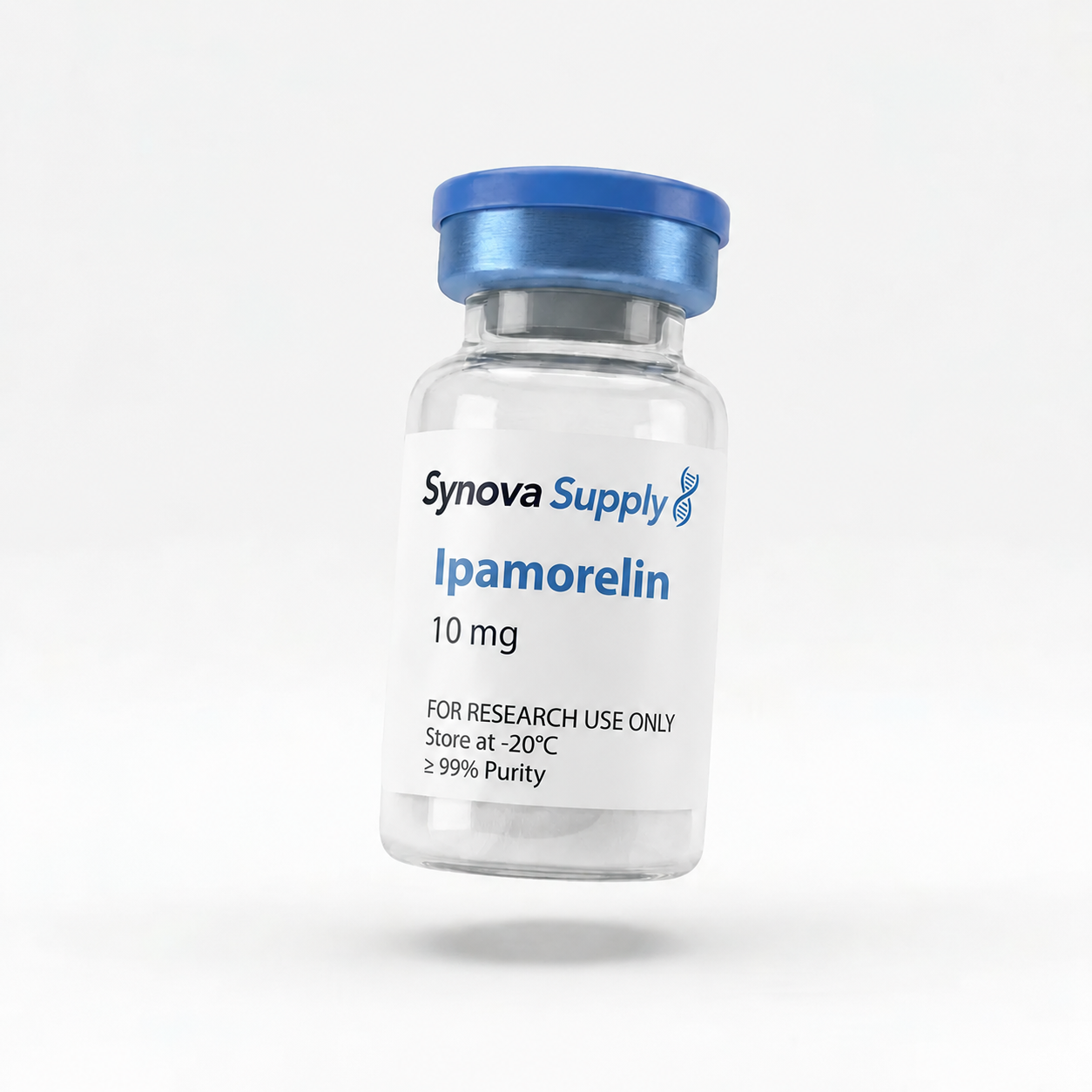
Description
Ipamorelin is a synthetic pentapeptide with the sequence Aib-His-D-2-Nal-D-Phe-Lys-NH2, developed as a selective growth hormone releasing peptide (GHRP) and ghrelin receptor agonist. First described by Novo Nordisk researchers in 1998, it was developed specifically to address the selectivity limitations of earlier GHRPs such as GHRP-2 and GHRP-6, which produced significant cortisol and prolactin co-release alongside GH stimulation. Ipamorelin’s highly selective receptor pharmacology has made it one of the most studied GHRPs in the preclinical research literature, serving as a standard reference compound in somatotropic axis research.
Ghrelin Receptor Pharmacology Research Ipamorelin’s primary research significance lies in its selective agonism at the growth hormone secretagogue receptor type 1a (GHSR-1a), the endogenous receptor for ghrelin. Published binding studies have characterized its receptor affinity constants, selectivity profile, and downstream signaling through the Gαq/phospholipase C pathway leading to intracellular calcium mobilization and GH secretion from pituitary somatotrophs. Research has examined its receptor occupancy kinetics and the duration of GH pulse stimulation in both in-vitro pituitary cell culture systems and in-vivo animal models.
Selectivity Research — GH vs Cortisol and Prolactin The defining characteristic of ipamorelin in the research literature is its selectivity for GH release relative to other pituitary hormones. Published comparative studies have examined ipamorelin alongside GHRP-2 and GHRP-6 in rodent models, consistently demonstrating significantly attenuated cortisol and ACTH responses to ipamorelin compared to earlier generation GHRPs at equimolar doses. This selectivity profile makes ipamorelin a preferred research tool for studies seeking to examine GH-specific downstream effects without the confounding variables of concurrent HPA axis activation.
Somatotropic Axis Research Ipamorelin has been extensively used as a research tool for studying the hypothalamic-pituitary somatotropic axis. Published preclinical studies have examined its effects on GH pulse amplitude and frequency, IGF-1 production in response to GH stimulation, and the feedback regulation of the somatotropic axis in various animal models. Research has also investigated its synergistic effects when combined with GHRH analogues such as CJC-1295, with published data examining the additive effects of simultaneous GHSR and GHRHR stimulation on GH secretion amplitude.
Bone and Connective Tissue Research A notable area of ipamorelin preclinical research involves bone biology. Published animal model studies have examined its effects on bone mineral density, osteoblast activity markers, and longitudinal bone growth in young rodent models. Research has investigated the GH/IGF-1 axis mediation of these effects and compared ipamorelin’s bone-related outcomes to those of direct GH administration in relevant model systems.
Body Composition Research Preclinical studies have examined ipamorelin’s effects on body composition parameters in animal models, including its influence on lean mass preservation, adipose tissue metabolism, and nitrogen retention in GH-deficient and normal animal models. Research has explored the IGF-1 mediated mechanisms through which GH axis stimulation influences protein synthesis rates and lipolysis in peripheral tissues.
Gastrointestinal Motility Research Given ipamorelin’s activity at the ghrelin receptor — which plays a significant role in gastrointestinal motility regulation — preclinical research has examined its effects on gastric emptying, gut motility patterns, and ghrelin signaling in the enteric nervous system. This area of research reflects the broader biological significance of the GHSR-1a receptor beyond its pituitary GH-releasing function.
Combination Research with CJC-1295 Ipamorelin is among the most frequently studied peptides in combination research designs. Published preclinical literature has extensively examined the combined administration of ipamorelin with CJC-1295 (GHRH analogue), with studies demonstrating synergistic enhancement of GH pulse amplitude through simultaneous stimulation of both the GHSR and GHRHR receptors. This combination has become a standard research paradigm for studying maximal somatotropic axis stimulation in preclinical models.
Research Context Ipamorelin’s well-characterized selectivity profile, extensive published pharmacology data, and established use as a reference compound in somatotropic axis research make it one of the most useful research tools in the growth hormone secretagogue category. Its combination with CJC-1295 represents one of the most studied peptide pairings in the preclinical research literature.
Supplied as: Lyophilized powder, sealed vial Purity: ≥99.2% (HPLC verified per batch) Testing: Independent third-party mass spectrometry and HPLC Origin: United States Storage: −20°C, protected from light and moisture Reconstitution: Bacteriostatic water (not included)
For research use only. Not for human or animal administration. Must be handled by a qualified researcher in a licensed laboratory setting. This product is not approved by the FDA and is not intended for diagnostic or therapeutic use.
Reviews
There are no reviews yet.